

-
Recent Posts
- Innovation in a black tie
- G|Uganda Recap
- AfriLabs: The Founders Fund for Africa
- FrogMob Crowdsources Market Research
- Nnedi Okorafor: Storyteller
- Who’s Killing African Entrepreneurship?
- Hello Appfri.ca
- Open Tech Exchange Interview
- Mobile Gutenberg, Banking Papacy
- Inception
- The White House on Africa’s Tech Sector
- A Vision of the Present
- What is Hive Colab?
- Grassroots Diplomacy
- U.S. State Department’s Conversation with African Innovators
Most Emailed
- Infostate of Africa - 19 emails
- PayPal Alternatives for African Entrepreneurs - 5 emails
- 20 Ideas for Social Entrepreneurs [Part 1] - 5 emails
- Buying Water with M-PESA in Kenya - 4 emails
- More Fiber Optic in West Africa - 4 emails
- Zimbabwe Switches to Linden Dollars - 4 emails
- Great African Singularities - 4 emails
- Dutch Scientists Test Malaria Vaccine Delivery … Through Mosquitoes - 3 emails
- The Best and Worst Project Management Apps - 3 emails
- How to Shoehorn the High-Bandwidth Internet into a Low-Bandwidth Connection - 3 emails
Recent Comments
- Stafford Battle 在 In Search of… African Sci-Fi Novels 上的评论
- Wilhelm 在 What is Hive Colab? 上的评论
- John 在 World’s Biggest Classifieds Come to Kenya 上的评论
- Kevin | PAYG Phones 在 The TED Phone 上的评论
- david sahel 在 PayPal Alternatives for African Entrepreneurs 上的评论
- frizzelle 在 AfriLabs: The Founders Fund for Africa 上的评论
- Olivier 在 AfriLabs: The Founders Fund for Africa 上的评论
- Adrian Hall 在 Infostate of Africa 上的评论
- watsonovedades 在 Infostate of Africa 上的评论
- Ezee 在 Analyzing Africa’s Internet Traffic 上的评论
- Motivation Nigeria 在 The Grid Launches in Nigeria 上的评论
- chikwe 在 Inception 上的评论
- What is Hive Colab? | Beyond The First World 在 What is Hive Colab? 上的评论
- the rasx() context » Blog Archive » “Who’s Killing African Entrepreneurship?” and other links… 在 Who’s Killing African Entrepreneurship? 上的评论
- Jordan 在 A Fragmented Africa 上的评论
- Billy Branks Kaye 在 What is Hive Colab? 上的评论
- theafrican 在 Great African Singularities 上的评论
- Jun 在 Mobile Gutenberg, Banking Papacy 上的评论
- Su Kahumbu 在 Map of African Country Codes (Infographic) 上的评论
- jongos 在 On Love and Hate for 160 characters 上的评论
Featured Story
Spotlight
On Love and Hate for 160 characters

Is the growing skepticism on SMS warranted? One of the most rewarding aspects of running this company has been our International Fellows Program which invites … Read More
The Open Source Embargo

Or “Separate but Equal hits the Open Source Community”. I wrote a blog post a while back about location based profiling on the web. Many websites … Read More
Recent Articles
G|Uganda Recap
Google's G|Uganda Conference held at Kampala's Speke Resort Munyonyo.
On September 1st Kampala saw the kick off of Google’s gUganda, which was held at the Munyonyo Speke Resort Commonwealth Conference Centre. 650 Engineers, Designers, Web Developers, Entrepreneurs and Students learned how Google hope to spur Tech Innovation and Entrepreneurship in Africa and even closer to home Uganda.
“Africa’s the final frontier.”- Google. Hearing this I felt as If I were sitting inside the USS Voyager and we were about to go into Google deep space. And, who do you ask is the captain of this Tech journey? Nelson Mattos Engineering Vice President for Google Europe, Middle East and Africa (EMEA), mentioned that for every 10,000 people in Africa there is 1 domain. In comparison to most Western Countries which have up to 94 domains for every 10,000 people. The Google VP a keynotes speaker at the event commented “We are very pleased to be hosting our first big developer event which will engage the local Tech and Business communities, and highlight the opportunities of the web. Our aim is to make the internet more locally relevant and useful to Ugandans, and help build a viable and sustainable internet ecosystem in Africa.”
Now I know to a lot of people that might think that is just a really good pitch, but what’s the catch? I mean most of the time when something sounds too good to be true, it usually is. That doesn’t have to be the case according to Google who across the two day conference demonstrated to Tech Professionals and Entrepreneurs alike how Google’s straight forward and cost friendly (Free) tools and applications can be used to keep African content in Africa through internet exchange points (IXPs) also known as Google cache, create a greater online presence e.g. through applications like Google Maps and more locally relevant information, tools and applications. Through a sort of “Democratization” of locally relevant content if you will, along with trying to inspire people across the continent to innovate and optimize the opportunities available to create a more significant online presence for Ugandans and Africans alike. “Less than 10% of Africa’s users contribute to more than 1% of Africa’s Content.”- Google.
I wasn’t really sure what to expect the second day of the Google event since the day was heavily centred on Tech Entrepreneurship and how we can all use Google and their products such as Google’s Web Optimizer, Adsense (www.google.com/adsense) , Adwords (www.adwords.google.com) , Analytics (www.google.com/analytics/ )and Google Apps (www.google.com/a/ ) to create and maintain a successful online business, Cha ching! Now I am no Donald Trump but by the end of it all I felt that even I should be able to come up with an online income generating idea too. The Google team did a great Job of breaking down each of the online products on offer along with a demonstration and very interactive Q&A. The second day along with the two day conference was concluded with a panel discussion with a few successful home-grown Tech Entrepreneurs such as, Eric Kamau (www.trueafrican.com),
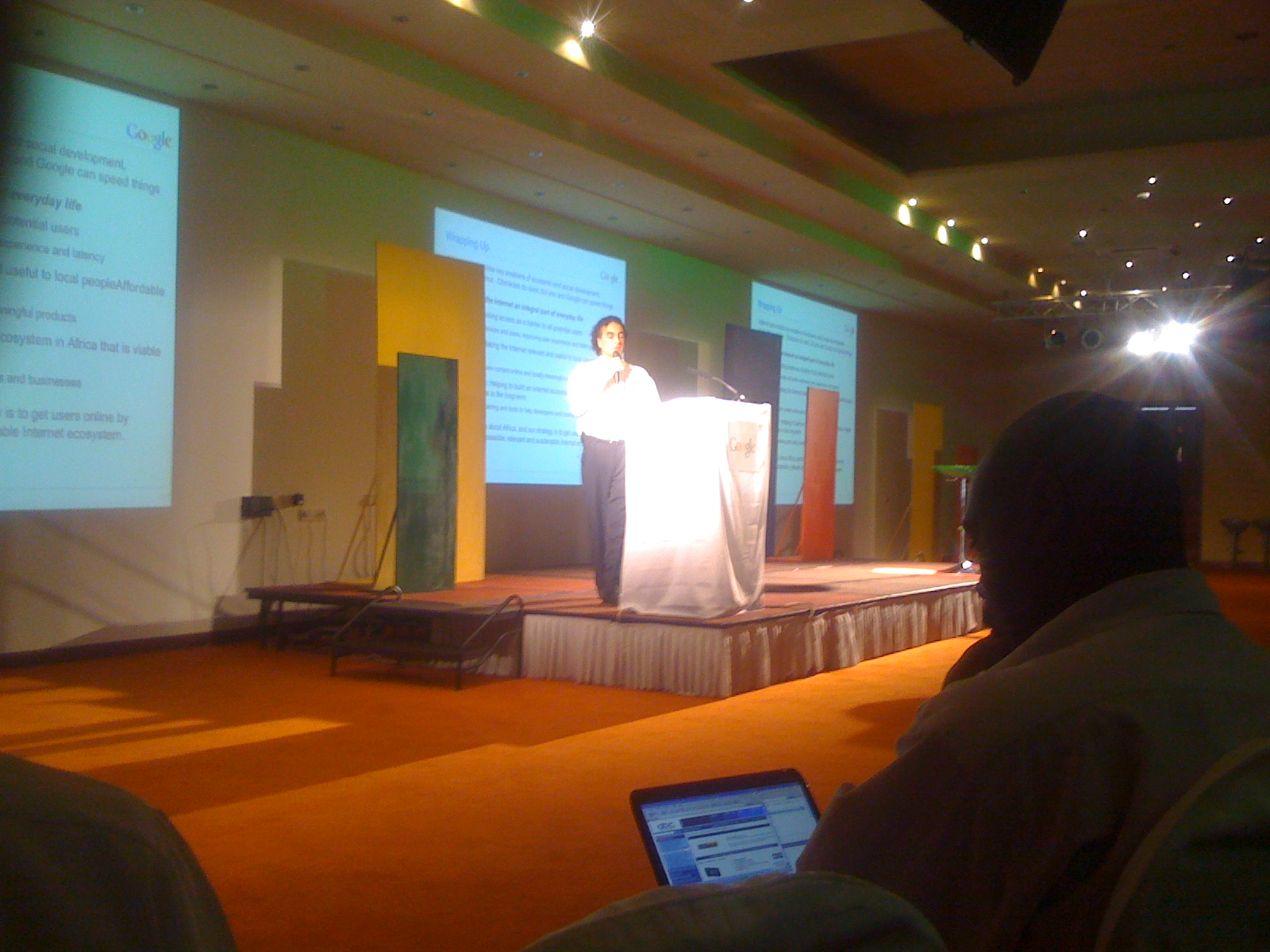
Nelson Mattos, Engineering Vice President for Europe, Middle East and Africa discussing that the tech future of Uganda and Africa is only on the up.
Benge Solomon King (www.nodesix.com) and Simon Kaheru Director of SMS Media along with a few others and the giving way of a Google Nexus one Android handset.
I will say by the end of the two days I had fried a few mental circuits but feel I have walked away with some sort of divine digital knowledge, having momentary access to what felt like an infinite source of opportunity. Now I wait with bated breath for next event. Have a look at the blog to find out about any up and coming events in your region www.google-africa.blogspot.com.
AfriLabs: The Founders Fund for Africa

Today Appfrica and Hive Colab are happy to announce our participation in the cofounding of AfriLabs.
On March 3rd 2010, founders from several established African tech incubators and open collaboration spaces @HiveColab @iHub @Appfrica Labs @NaiLab @Bantalabs @LimbeLabs came together for the iHub launch in Nairobi. The meeting hosted by Nailab (an iHub neighbor) made clear that each of the labs shares in a common vision to promote technology as a platform for entrepreneurship on the continent. The labs have a lot to gain by working together and it was in this thinking that Afrilabs was born.
FrogMob Crowdsources Market Research

Frog Design, the global innovation and design firm is experimenting with a ‘method of guerilla research’ that let’s anyone submit photos related to specific campaigns. The idea is to cast a lens on the ‘long tail’ of product use and consumption around the world to inform new design and marketing decisions…
An experimental method of guerilla research developed by global innovation firm frog design, frogMob is based on the idea that anyone can channel their inner design researcher by looking for inspiration from everyday life. Tapping into frog’s global networks and the broader community, frogMob encourages people from all over the world to submit their photos and stories to help us take a quick pulse on emerging trends that can inform our design process.
Nnedi Okorafor: Storyteller

It was through the blog IO9 that I discovered Nnedi Okorafor’s uniquely African take on science-fiction and fantasy last month. Nneddi, a second generation African immigrant to America, is making a name for herself with her novels “Zahrah the Windseeker” and “Who Fears Death” and is helping to redefine two genres of fiction where Africa is greatly under-represented. Her latest is Akata Witch, a fantasy narrative set in present-day Nigeria.


Mobile Gutenberg, Banking Papacy
“The mobile phone is like the printing press, so who’s the Church?” - Emrys Schoemaker This afternoon I had the pleasure of having lunch with Emrys … Read More